 Speaking the truth... | Town Crier News Nigeria | Whatsapp No: 08027723347, 08072777599,08122784467,09063474539

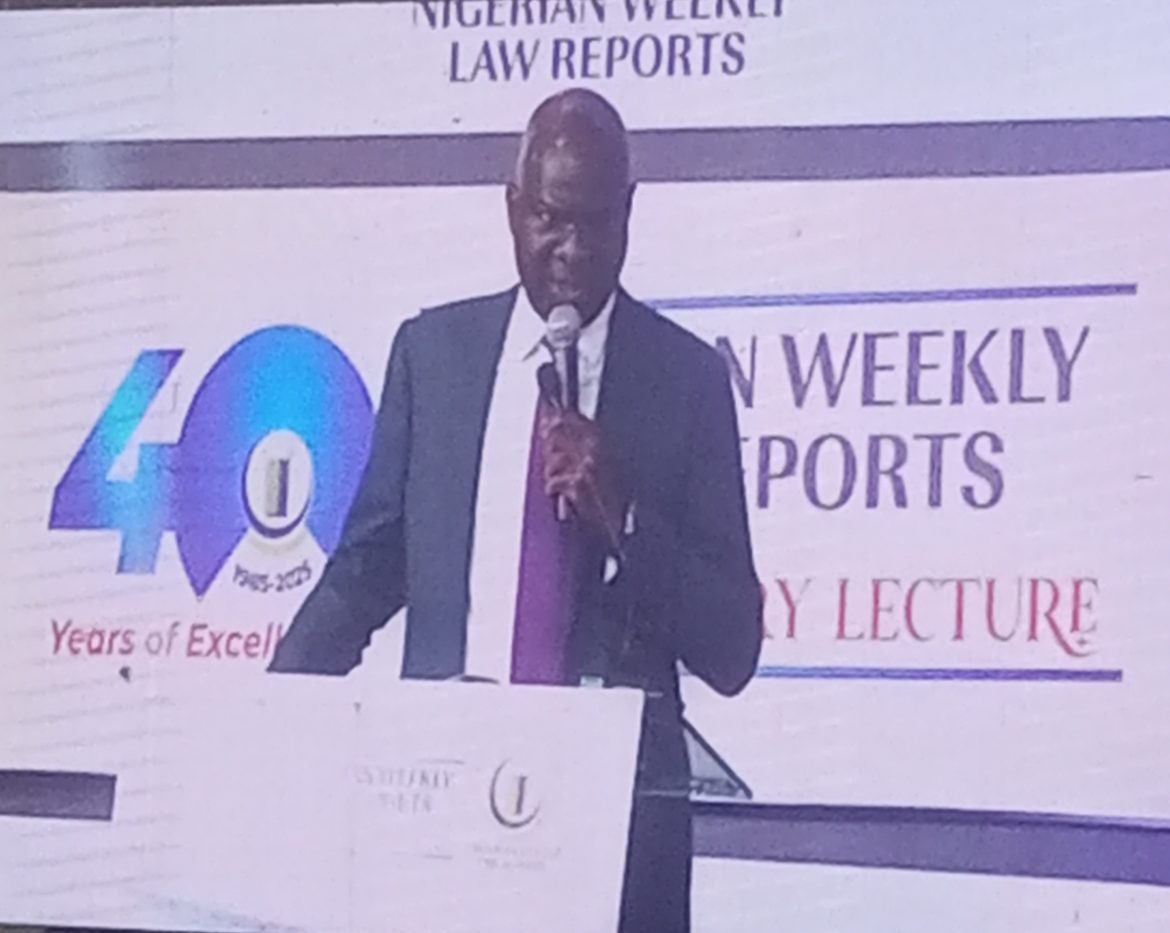
Fashola Calls for Safeguarding the Legacy of Law Reporting in the Age of Artificial Intelligence
Written By Dedeigbo Samson Ayodeji
Posted By Town Crier News Nigeria
Published By Fitness Network Communications
At the Civic Centre, Victoria Island, Lagos, on Thursday, October 9, 2025, former Minister of Works and Housing and Senior Advocate of Nigeria, Babatunde Raji Fashola, SAN, CON, delivered a thought-provoking lecture to commemorate the 40th anniversary of the Nigerian Weekly Law Reports (NWLR), established by the late Chief Abdul-Ganiyu Oyesola Fawehinmi, SAN. The lecture, titled “Safeguarding the Legacy of Law Reporting and Embracing the Future in the Technological Era,” celebrated Gani Fawehinmi’s enduring contributions to law reporting in Nigeria while addressing the emerging challenges posed by artificial intelligence in the legal profession.
Fashola began by paying glowing tribute to Chief Gani Fawehinmi, describing him as a relentless reformer who used law as a tool to pursue justice and equity in Nigeria. He noted that even without the NWLR, Gani’s work as a human rights activist and advocate of public interest litigation would have immortalised him. However, Gani’s venture into law reporting, Fashola said, revolutionised access to legal knowledge and democratized the practice of law in Nigeria.
Before the establishment of the NWLR in 1985, Fashola recalled, access to recent court judgments was limited to a few privileged lawyers in Lagos, who often gained unfair advantage in court by citing fresh Supreme Court decisions unavailable to others. Gani disrupted this inequitable system by creating the NWLR to ensure that lawyers across the country could access court decisions in record time. Though the early editions excluded Court of Appeal decisions, their eventual inclusion marked a major shift that levelled the playing field in legal practice.
Fashola acknowledged that Gani faced criticism, including accusations of monopoly and profit-seeking, but stressed that such criticisms were baseless compared to the immense benefits the NWLR brought to the legal system. He commended the Fawehinmi family and the management of the NWLR for sustaining Gani’s vision over four decades, despite the collapse of many other law reporting ventures.
Quoting Gani’s editor’s note in the maiden 1985 edition of the NWLR, Fashola reminded the audience that the goal was to make Nigerian laws “available to all and sundry as quickly as possible,” thereby ensuring that justice was more learned and accessible. He further highlighted Gani’s expansion of the law reporting canon through other publications, including the Nigerian Constitutional Law Reports and the Supreme Court of Nigeria Law Reports, which documented both reported and previously unreported Supreme Court judgments between 1956 and 1984.
According to Fashola, Gani’s meticulous efforts in compiling unreported cases not only supported the development of Nigerian jurisprudence but also enhanced the nation’s judicial independence and international reputation. The creation of NWLR Online in 2019, he added, demonstrated the publication’s adaptability to the digital age and its global relevance in arbitration and international legal proceedings involving Nigerian law.
Turning to the theme of the lecture, Fashola observed that while technology has advanced law practice from the typewriter to desktop publishing, from fax to email, new challenges are emerging with the advent of artificial intelligence. He expressed concern about the growing trend of lawyers citing fictitious, AI-generated court decisions, warning that such “hallucinated” judgments threaten the integrity of precedent and the principle of stare decisis.
Citing examples from the United Kingdom, he referred to Judge Victoria Sharp’s ruling on the unreliability of generative AI tools like ChatGPT, which she said could produce “coherent and plausible responses that are simply untrue.” He also noted that in some recent UK cases, lawyers had cited dozens of non-existent or misrepresented cases, underscoring the global nature of the problem.
Fashola warned that such practices could distort legal doctrine, undermine the sanctity of precedent, and erode trust in the justice system. He referenced landmark Nigerian cases such as Margaret Chinyere Stitch v. Attorney-General of the Federation (1986), N.A. Williams v. Hope Rising Voluntary Funds Society (1982), Adegoke Motors Ltd v. Adesanya (1989), and Idundun v. Okumagba (1976), which remain cornerstones of Nigerian jurisprudence and examples of why authoritative law reporting must be preserved.
Drawing from the book The Age of AI by Henry Kissinger, Eric Schmidt, and Daniel Huttenlocher, Fashola noted that AI “can create vast amounts of false but plausible information” and “does not possess common sense,” making human oversight indispensable. He explained that while AI offers opportunities in research, medicine, and data processing, it cannot discern context or intent, making it prone to errors that could have grave implications for law.
To mitigate these risks, Fashola advocated for a “Human in the Loop” approach, where human expertise supervises AI-generated work. He called for collaboration among legal institutions, including the Bar, the Bench, law schools, and the Body of Benchers, to set professional standards for AI use in legal research and practice. He also urged editors of law reports to ensure accuracy, cautioning that editorial notes must never distort judicial decisions.
Fashola concluded with a call to action, emphasizing that if Gani Fawehinmi were alive, he would have taken the lead in addressing these challenges. He urged the Chief Justice of Nigeria, Hon. Justice Olukayode Ariwoola Kekere-Ekun, to spearhead efforts to safeguard the legacy of law reporting through appropriate rules and policy reforms, leveraging the constitutional powers of the Supreme Court and the National Judicial Council.
He further encouraged the Ministries of Justice, Law Reform Commission, Nigerian Bar Association, and the Ministry of Communication, Innovation, and Digital Economy to collaborate in protecting the integrity of law reporting in the technological era.
In his closing remarks, Fashola reaffirmed that while artificial intelligence presents both promise and peril, the future of law reporting depends on human integrity, vigilance, and commitment to truth. “Like roses that have thorns,” he said, “we must embrace AI, use its positives, and avoid its perils.”
The event ended with applause as the audience honoured the enduring legacy of Chief Gani Fawehinmi, whose vision continues to shape Nigerian law and inspire generations of legal practitioners.