 Speaking the truth... | Town Crier News Nigeria | Whatsapp No: 08027723347, 08072777599,08122784467,09063474539

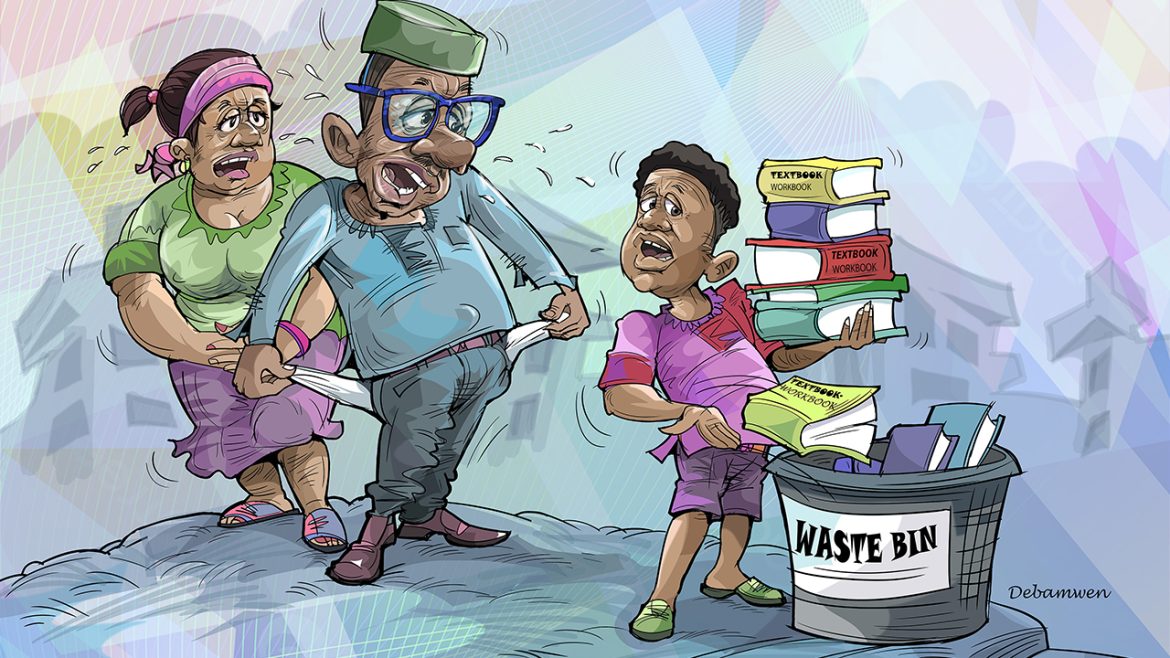
CLASSROOM OR CASH REGISTER? How Nigerian Schools Are Turning Textbooks Into Business
Written By Dedeigbo Samson Ayodeji
Posted By Town Crier News Nigeria
Published By Fitness Network Communications
Every September, the same quiet extortion plays out in Nigerian homes.
A mother brings out the box of textbooks her first child used two years ago clean, complete, perfectly usable for her second child.
She already knows the school’s answer: “We can’t use that one again. We now use the write-in edition.”
It is the same book. Same content. Slightly different cover.
The only difference is that blank lines have now been printed directly into the pages so the child must write inside the textbook.
Once filled, the book is dead.
It cannot go to a younger sibling, a cousin, or a neighbour.
It goes to the bin.
A book that could serve five children for ten years has been engineered to serve one child for one year.
That is not pedagogy. That is a business model.
Let us call it what it is.
When a school converts every textbook into a workbook, it is not because pupils learn better.
It is because the supplier arrangement pays better.
Parents can feel it even when they can’t prove it.
The booklist changes though the syllabus hasn’t.
The “approved” titles are sold only in the school or only at one shop.
Last year’s edition is suddenly “outdated” even though the topic is fractions, and fractions have not changed in 500 years.
The cost crushes the families least able to carry it.
A household with three children is not buying one set of books; it is buying three new sets every single year, with no relief.
In an economy where a bag of rice is now a negotiation, that is not a small line item.
It is the reason some children start the term without books, share one copy with a classmate, or resume late because the money hasn’t come.
And here is the most painful part: No child learns better because of it.
There is no evidence that a child understands fractions more deeply because his sister’s copy cannot be reused.
The only thing the write-in model reliably improves is the revenue line.
This is what happens when education quietly turns into retail.
When a school begins to measure success by what it can sell parents books, uniforms, branded stationery, “compulsory” extra lessons and levies nobody can explain the child at the centre stops being a learner.
He becomes a customer’s dependent. The classroom becomes a toll gate.
The solution is not complicated.
Schools should adopt durable textbooks that last 3-5 years and state it upfront.
Separate the expensive, reusable textbook from a thin, cheap workbook, so only the small part is replaced.
Run a book-swap shelf at the start of every term.
And where schools won’t do it on their own, regulators must act. State Ministries of Education should compel schools to publish booklists early, ban exclusive supplier deals, and give parents a real channel to challenge unjustified changes.
Parents also have more power than they think. At the next PTA meeting, ask the uncomfortable question loudly: Why can’t we reuse last year’s edition? Who benefits from this change? Schools hate answering that in front of a room.
Education is supposed to be the great equaliser.
It cannot play that role if every family must buy the same book again and again, simply because someone printed lines on the page.
A classroom should be the one place in a child’s life where nobody is ringing up a sale.